Table of Contents
Introduction
User experience (UX) in 2026 has evolved far beyond simple usability. It’s no longer just about intuitive navigation or attractive buttons - it’s about creating meaningful, adaptive, and human-centered interactions that continuously adjust to users’ needs. As digital ecosystems grow more complex, design teams must integrate research, accessibility, storytelling, AI-driven personalization, and rapid iteration to craft experiences that truly resonate.
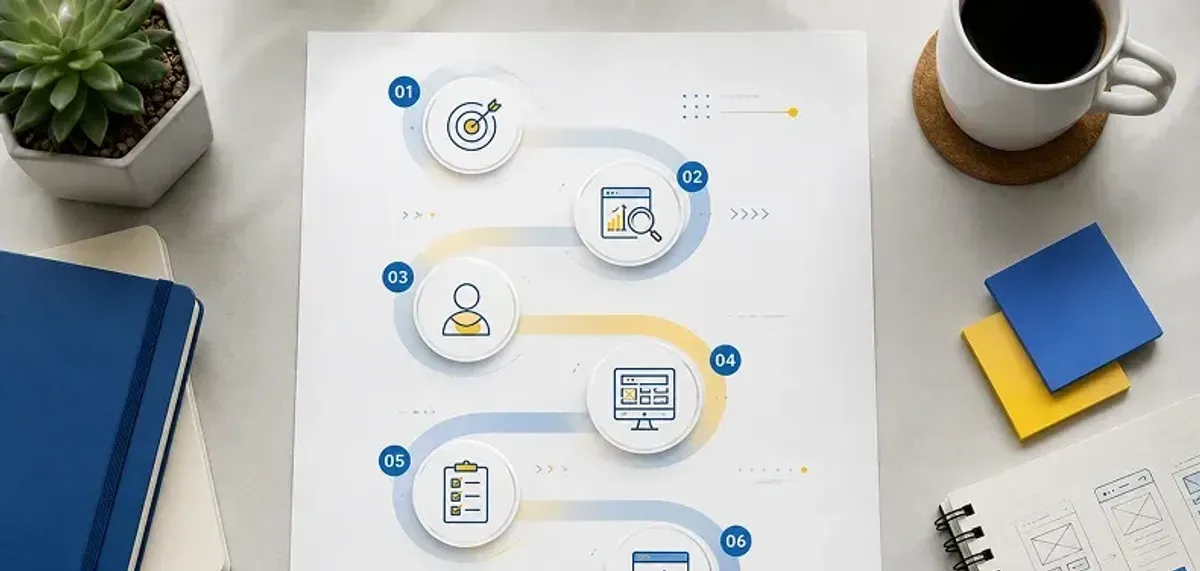
Here’s a 7-step framework that combines timeless UX principles with cutting-edge 2026 practices - supported by expert insights and real-world case studies.
1. User-Centric Discovery and Research
Empathy remains central to UX: solving real problems for real people. In 2026, discovery goes beyond workshops and surveys, enhanced by AI-powered research platforms that analyze feedback at scale and in real time.
For example, a MedTech startup redesigned its patient portal using AI dashboards to analyze video interviews, chatbot logs, and clinician notes. This revealed deeper issues - not just usability, but privacy and trust concerns that influenced patient engagement.
Similarly, an auditing firm used AI-enhanced workshops to uncover workflow inefficiencies. The result was recommendations for LLM-powered reporting tools that improved both speed and accuracy (Quantspark case study).
Surveys show 77% of designers prioritize user feedback before major updates. Tools like Dovetail AI and Insight cut analysis time from weeks to hours, helping teams keep pace with user needs.
From Coping with Uncertainty in UX Design Practice (2026): designers note that ambiguity is a significant aspect of their work. They describe changing stakeholder expectations, lack of resources, and new technologies as issues that are largely dealt with through adaptive framing and expert judgement as opposed to following inflexible roadmaps. (Source)
In the UX industry, 87% of respondents affirmed that UX design is now aligned with their business strategy, and 88% of online consumers said they are less likely to return after a bad experience with a website. (Source)
These suggest that discovery is about gathering insights and staying anchored amid uncertainty, and owning UX’s role in strategic resilience.
2. Accessibility and Inclusive Design
Definition: Accessibility has shifted from a compliance task to a core design philosophy. In 2026, inclusivity spans web, mobile, AR/VR, and even neural interfaces.
Take Froggipedia, an AR biology app. It added voice guidance, simplified gestures, and high-contrast modes so students with impairments could participate in dissections virtually. Similarly, AR/VR platforms now integrate voice navigation, haptics, single-button input, and captions (Hurix blog).
Accessibility is also delivering social impact. Over 70% of UX/UI designers now embed inclusive design early in the wireframing stage (Coveo). Inclusive systems expand reach, build trust, and ensure longevity across industries like healthcare, education, and government.
Designing for edge cases often sparks innovations that benefit everyone.
Fresh angle:
- Brand perception & loyalty: 96% of users say accessibility enhancements improve how they view a brand.
- Demonstrated correlation between inclusive design and reduced support costs, increased engagement, and fewer compliance risks.
Designing for edge cases often sparks innovations that benefit everyone and in 2026, it's less an optional kindness, more a competitive differentiator.
3. Adaptive Information Architecture (IA)
Information Architecture determines whether users feel supported or overwhelmed. In 2026, adaptive IA reshapes content based on context, intent, and even emotional state.
For instance, BlaBlaCar’s booking flow simplified screens to just a few choices, cutting cognitive load and reducing support tickets by 40%.
Outside of apps, adaptive microlearning research demonstrates how tailoring content to a learner’s knowledge reduces cognitive strain (Nature, 2024). The same applies in product design: clarity and flexibility together improve success rates.
With shorter attention spans, clarity is key. AI now drives dynamic navigation flows that adapt to behavior, making IA more human and less rigid.
Additional expert evidence:
- AI tools are now helping generate wireframe and layout options automatically based on user behavior metrics. Approximately 48% of teams are using AI to produce alternate structures in real time.
- Predictive UX implementations are reducing task-completion time by 35%, according to recent Forrester-linked data. (Source)
In short: adaptive IA isn't just smart-it’s necessary where users expect digital experiences to “just know” what they need next.
4. Real-Time, Continuous Feedback Loops
Traditional UX relied on post-launch studies. In 2026, feedback is real-time and contextual.
Take Miro’s micro-onboarding: banners appear only when users first try a feature, offering guidance in the moment. This halved onboarding time and reduced early churn.
Tools like Survicate and Commented.io now capture instant usability insights without language barriers (Survicate). This enables faster iteration while reducing user frustration.
Research shows feedback-driven products retain 20-30% more users. Users want support exactly when they need it, not weeks later.
New stats:
- Real-time personalization remains elusive - only 12% of companies consider themselves leaders in implementing it, despite more than half lagging behind. (Source)
- Adaptive feedback-driven products retain 20-30% more users. While this stat appeared earlier, it's reinforced by newer studies showing feedback timing is as important as content.
To stay ahead, UX teams must bake feedback into flows-not treat it as a separate phase.
5. Storytelling and Emotional Design
While functionality draws users in, emotion keeps them. Storytelling turns products into experiences tied to identity and community.
A prime example is Spotify Wrapped, which gives users a personalized year-in-review, blending nostalgia with data to drive social buzz. Likewise, Nike’s app challenges turn personal stories into community engagement.
Studies show visual storytelling, typography, and color psychology amplify emotional connections (Ramotion). Many UX teams now hire narrative designers to craft experiences with emotional depth
Emotional engagement leads to loyalty, advocacy, and retention. Stories help products stand out in crowded markets.
Warning signs / balance:
- Some users felt the 2024 Wrapped fell flat: “boring,” “lazy,” “lacking creative detail” compared to previous years. The Express Tribune+2Reddit+2
- Research (Utrecht University) shows critical reflection - users creating collages that challenge Wrapped’s self-identity framing - suggests personalization alone isn't enough: emotional design must also respect nuance.(Source)
Storytelling isn't just adding emotion - it’s crafting emotionally coherent experiences that avoid feeling superficial or purely performative.
6. Personalization and Predictive AI
In 2026, one-size-fits-all experiences are outdated. AI enables products to predict and anticipate needs.
Consider Spotify’s “Discover Weekly”, which predicts user taste to surface new music. Similarly, e-commerce brands now personalize layouts, offers, and timing to user activity. One DTC brand saw a 27% conversion boost by tailoring homepage experiences to morning visitors.
Consultancies note that tools like Dynamic Yield and Adobe Sensei are standard for dynamic UI personalization (Aufait UX).
Personalization is now expected. Predictive design reduces friction, increases relevance, and drives conversion.
Broader data underscores the trend:
- 80% of websites will use AI for personalized content, product recommendations, or UI by 2026 (Gartner/Forrester). (Source)
- 40% of loyalty marketers still struggle with personalization; 30% find measuring ROI difficult. (Source) More than half of businesses have not prioritized real-time personalization; only 12% see themselves as leaders. (Source)
Branders also face trade-offs: personalization boosts engagement, but overly narrow recommendations can reduce diversity of usage (as seen in Spotify studies). (Source)
7. Iteration, Measurement, and Adaptivity
UX is an ongoing cycle, not a one-time task. The best products evolve through continuous testing and measurement.
One e-commerce platform embedded micro-surveys and passive analytics in checkout flows, running weekly A/B tests. Small tweaks cut cart abandonment by 18% and raised NPS scores.
Research shows iteration with tools like Maze, Hotjar, and AI synthesis platforms reduces cycle times by up to 3x (Visnetwork). This agility ensures alignment with both user and business goals.
Iteration bridges empathy and execution, turning insights into growth.
Final Thoughts
Mastering UX in 2026 requires balancing empathy and innovation. From discovery to iteration, success means listening to users, embracing adaptive tech, and designing experiences that are both inclusive and predictive.
Whether building apps, SaaS platforms, or AR tools, this 7-step framework equips teams to create with purpose and impact. Embedding these principles not only boosts user satisfaction but also drives sustainable business growth.
.png&w=640&q=75)