
Table of Contents
The digital landscape has reached a point of no return. In early 2024, AI was a novelty-a "nice-to-have" plugin in a designer's toolkit. By late 2026, the paradigm has shifted entirely. We are no longer designing static pages; we are orchestrating intelligent ecosystems.
In this deep-dive guide, we will explore why the integration of artificial intelligence into the design process is the most significant competitive advantage of the decade. We’ll look at the measurable ROI, the psychological shifts in user behavior, and the proprietary Anarish Workflow that turns AI from a buzzword into a value multiplier.
1. Defining the New Frontier: What AI In UX Design Really Means in 2026
To master the current landscape, we must distinguish between two fundamental shifts: Internal Acceleration and External Evolution.
AI for UX (The Internal Workflow Accelerator)
This refers to how designers use machine learning and generative models to perform their jobs. According to research by Neuron, AI is shifting the designer's role from "pixel pusher" to "systems curator." It’s about efficiency: using LLMs to synthesize thousands of hours of user interviews or using AI-driven heatmaps to predict eye-tracking before a prototype is even launched.
AI in UX (The External Value Multiplier)
This is what the user experiences. It is the product's ability to learn from the user. It manifests as Predictive UX (anticipating the next task), Generative UI (interfaces that reconstruct their layout in real-time), and Adaptive Content. When we talk about AI in UI UX design for our clients, this is where the massive business growth happens.
2. The Hard Data: Why Your Business Can't Wait
If you’re a founder or a PM, you might ask: "Is this just hype?" The data from 2026 says a resounding no.
- The 10,000% ROI Rule: For every $1 invested in high-quality UX, the average return is $100. MindInventory reportsthat a well-executed UI can amplify conversion rates by almost 200%, while a seamless UX can yield an increase of up to 400%.
- The "Ghosting" Reality: 88% of users are unlikely to return to a site or app after one bad experience. In the era of AI, a "bad experience" now includes a product being too slow to understand what the user wants.
- Personalization Premiums: ProCreator Design highlights that 71% of consumers expect brands to provide personalized experiences, and brands that do so see a 20% boost in sales.
3. The Anarish "AI-First" Design Workflow
Phase 1: AI-Augmented Research & Discovery
Traditional research takes weeks. We accelerate this using Sentiment Analysis and Cluster Modelling. By feeding raw user feedback into our custom AI models, we identify "Invisible Friction Points"-issues users didn't even know they had.
- Predictive Heatmapping: We use tools like Attention Insight to validate layouts. If the AI predicts a user will miss the CTA, we fix it before it ever goes to a developer.
Phase 2: From Static Wireframes to "Dynamic Logic."
In 2026, we don't just design "screens." We design Logical Systems.
- Semantic Tokens: We assign metadata to every design element. A button isn't just "Blue"; it’s a "Primary Action." This allows an AI-driven interface to change that button's color or size if the user is in a "high-stress" context.
- Rapid Scenario Exploration:We use generative AI to brainstorm 50+ user stories in minutes, ensuring we cover the "edge cases" that traditional teams miss.
Phase 3: Generative UI & Prototyping
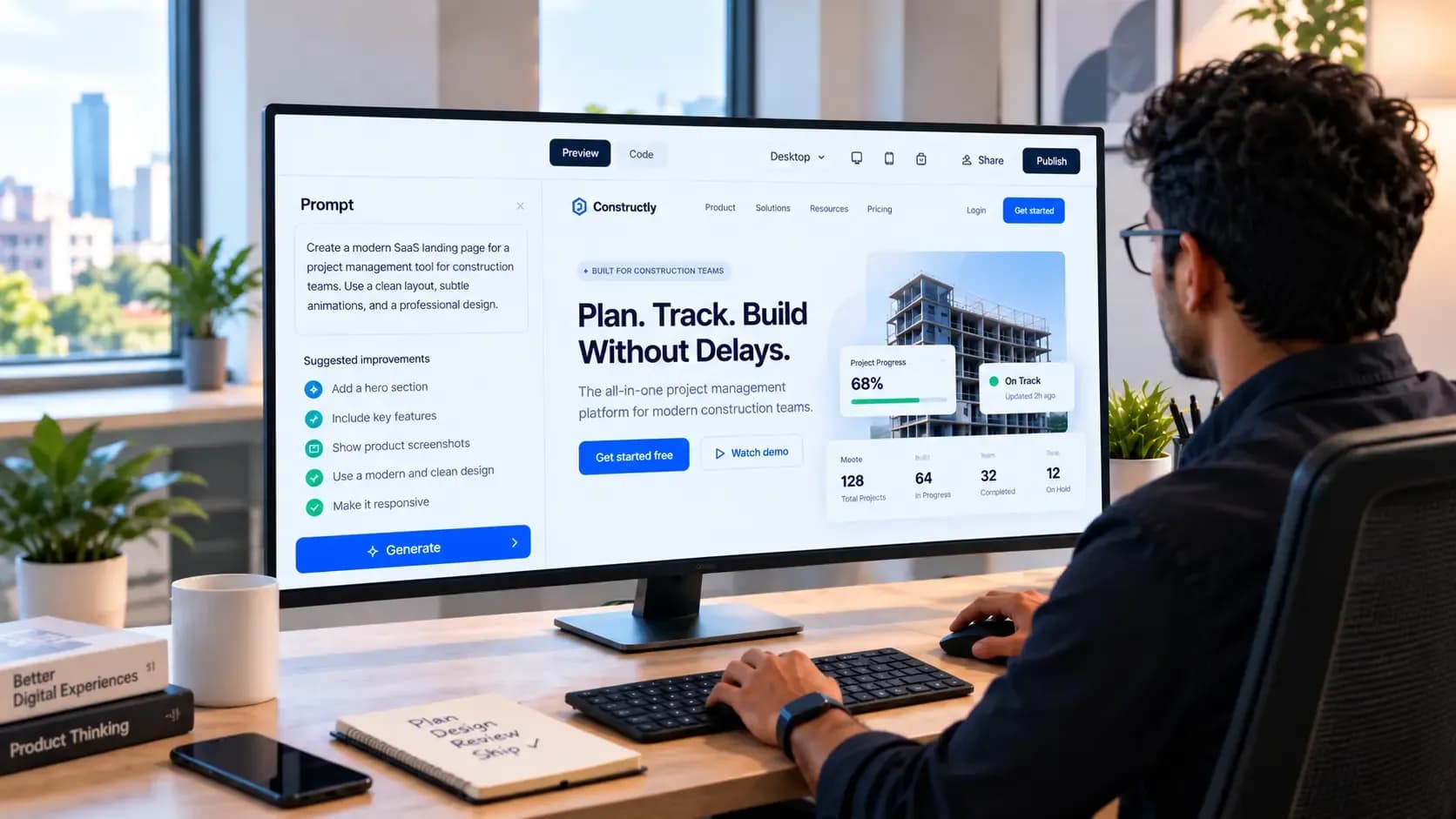
We use advanced tools like Figma AI and Uizard to turn high-level concepts into high-fidelity prototypes. Uizard’s Autodesigner allows us to generate entire app screens from text prompts, which we then refine with human precision.
Impact: This approach cuts initial prototyping time by 50-60%, allowing us to iterate faster and deliver production-ready designs in days instead of weeks.
Phase 4: Self-Healing Optimization Loops
The design doesn't end at launch. We implement Continuous Personalization Loops. The AI monitors user behavior and subtly adjusts the UI-moving frequently used menu items to the top or simplifying the checkout flow-until the product reaches peak performance.
4. Designing for Trust: The Explainable AI (XAI) Layer
The most significant challenge of AI in UI UX design in 2026 is not capability, it’s trust. If a user feels an AI is a "black box," they will hesitate.
The XAI Framework at Anarish
We build "Explainability" into every product using these pillars:
- Confidence Indicators: We show how sure the AI is (e.g., "98% Match").
- Rationale Tooltips: A "Why am I seeing this?" button that explains the logic (e.g., "Based on your last three searches...").
- Human Autonomy: Parallel HQ’s Ethics Guide emphasizes that people should always be able to override AI decisions. Every AI action must have a clear "Undo" or "Edit" path.
5. Case Studies: The AI Design Transformation in Action
Spotify: Beyond the Playlist
Spotify adopted AI-powered UX testing tools to identify usability issues that manual testers missed. By leveraging predictive impact models, they prioritized design fixes that led to a measurable increase in platform stability and session length.
Netflix: Personalizing the Visuals
Netflix doesn't just recommend movies; they use AI to deliver hyper-personalized content layouts. DigitalDefynd notes that by adapting thumbnails to individual user tastes, Netflix reduced browsing time by nearly 30%.
Duolingo: Emotionally Intelligent Micro-interactions
Duolingo mastered the use of contextual responses. Their AI detects user frustration signals and provides empathetic feedback, turning a learning struggle into an engaging experience.
6. Visual Trends of 2026: The "Bento Box" and Beyond
AI has birthed new visual languages that are both functional and modular.
The Bento Box Layout
Popularized by Apple, the "Bento Box" uses modular grids to organize information. It is the ultimate responsive layout for an intelligent era because AI can easily "expand" one box to show a detailed chart and "shrink" another when it isn't relevan
Glassmorphism & Neumorphism 2.0
In 2026, we are seeing a return to "soft" interfaces. These styles use hazy transparency and subtle shadows to make AI agents feel more approachable and less "clinical".
7. The Ethical Imperative: Bias, Privacy, and Accessibility
- Bias Auditing:We test AI-generated designs against diverse user personas to ensure fairness across race, gender, and age.
- Privacy by Design:We implement data minimization, ensuring we only collect what’s necessary for personalization and providing clear opt-out mechanisms.
- AI for Accessibility:AI is a superpower for inclusivity. We use it to automatically generate high-quality alt-text and adjust color contrast for the visually impaired in real-time.
8. Looking Ahead: Zero UI and Ambient Intelligence
The 2026-2030 roadmap points toward Zero UI-the idea that the best interface is invisible.
- Voice & Gesture: Unico Connect highlights that "Zero UI" will rely on Siri, Alexa, and hand-tracking AR/VR to create seamless, hands-free navigation.
- Contextual Awareness: Your device will recognize that you are in a meeting and automatically shift your UI to a "Focus Mode" without you asking.
.png&w=640&q=75)